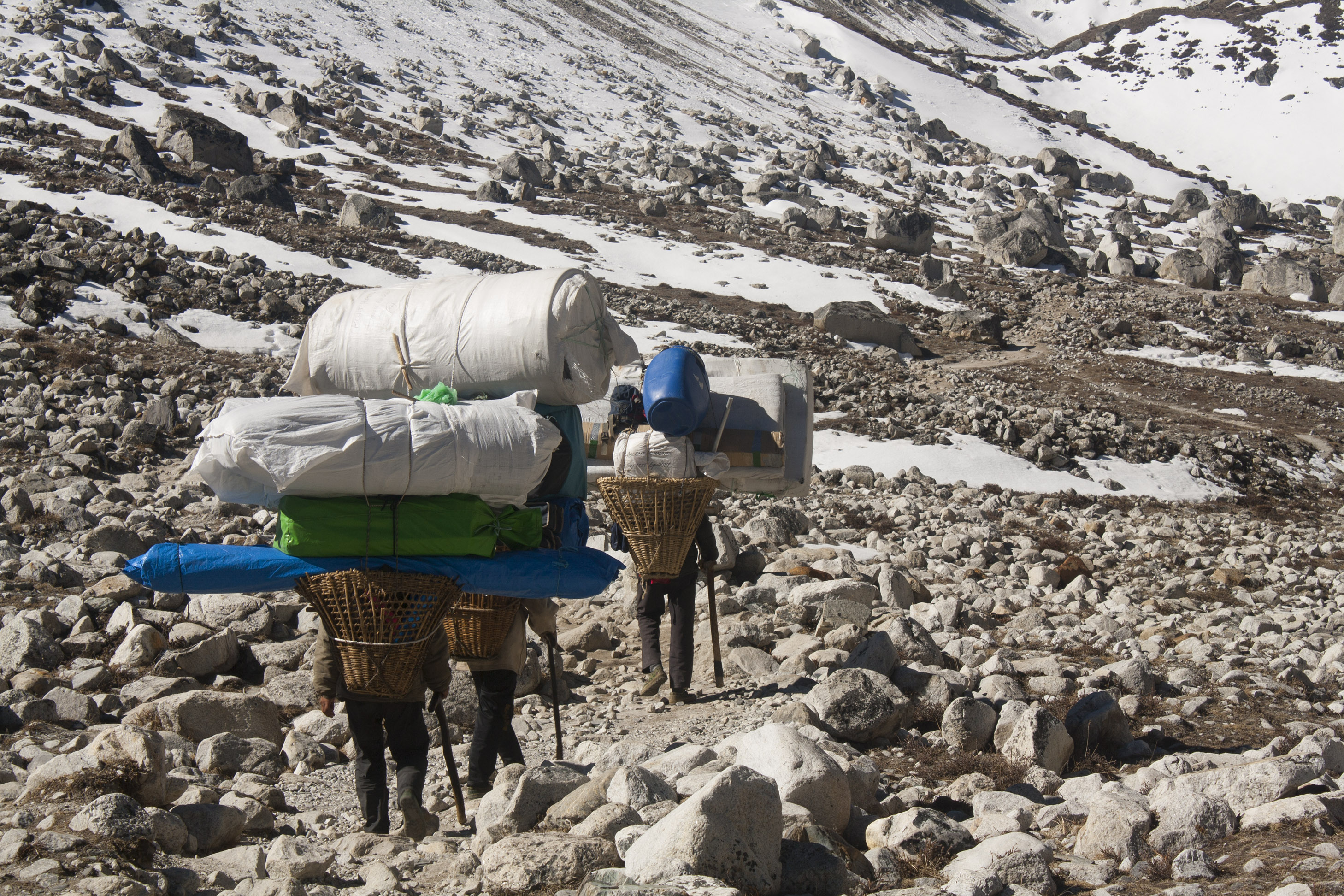
From the Himalayas to the ocean floor, the human body has developed remarkable ways of meeting its environment.
On the ocean floor, a child’s eyes adjust to a world that should be a blur. In the mountains, the chemistry of blood becomes a question of survival. Others whose bodies are unusually well equipped for life thousands of feet above sea level. Across the world, human populations have developed fascinating responses to the places they call home.
Some are inherited genetic changes; others emerge through childhood experience, cultural practice, or training. It is tempting to call these abilities superhuman, but that misses the point. The real science is more interesting: there is more than one way to be human.

01 / The People Who Make Thin Air Look Easy
Sherpa communities — Nepal
At elevations where visitors struggle to catch their breath, Sherpa mountaineers navigate the Himalayas with extraordinary expertise. Research suggests differences in how their muscles use fuel under low-oxygen conditions. This isn’t unlimited endurance: experience, technical skill, and knowledge of the mountains matter just as much as physiology.
The most remarkable detail is not a record or a summit. It is what happens inside the muscle: studies comparing Sherpa and lowland participants have found differences in mitochondrial function and the way fuel is used under hypoxic conditions. That biology belongs alongside a history of skilled mountain labor, guiding, and knowledge. The mountain is never conquered by a gene alone.
02 / Running Is More Than a Sport


Kalenjin runners — Kenya
Kalenjin athletes have an extraordinary record in elite distance running. Researchers have explored physiological traits, but no single gene explains that success. Altitude, training, coaching, running culture, and opportunity all belong in the story.
The temptation is to look at a medal table and imagine a biological shortcut. Yet athletes do not emerge from a laboratory. They grow up within sporting cultures, training systems, and communities where distance running can become both a practical skill and a professional ambition. Population averages cannot predict an individual’s talent.

03 / An Ancient Gift From Another Human Species
Tibetan highlanders — Tibetan Plateau
Tibetan populations have distinctive responses to low oxygen, including relatively moderate hemoglobin concentrations at altitude. An advantageous version of the EPAS1 gene has been linked to ancient Denisovan ancestry. Evolution sometimes draws on a very distant human past.
At high altitude, producing ever more red blood cells sounds like an obvious solution, but thicker blood can carry costs. Tibetan adaptation offers another answer. The EPAS1 story is especially astonishing because genetic evidence points to introgression from Denisovans: an ancient encounter between human lineages still matters to life on the plateau.
04 / Built for the Cold


Greenlandic Inuit — Arctic
Studies of Greenlandic Inuit populations have identified genetic variants associated with fat metabolism, including the TBX15/WARS2 region. But Arctic survival is also a story of clothing, food knowledge, architecture, navigation, and generations of cultural expertise.
This is where the word adaptation needs room to breathe. A genetic association with fat metabolism is one line of inquiry; the engineering of a warm garment, the ability to travel over sea ice, and food preservation are others. Culture is not a footnote to survival. It is one of its most sophisticated technologies.

05 / Seeing the Ocean Differently
Moken communities — Southeast Asia
Researchers found that Moken children had striking underwater visual acuity, using pupil constriction and lens accommodation. Other children later learned comparable skills through training. This extraordinary ability reminds us that adaptation is not always inherited.
Water changes the optics of the eye. Without goggles, the cornea loses much of its focusing power. In the original experiment, Moken children compensated by narrowing their pupils and changing the shape of their lenses. Later training studies showed that children elsewhere could learn similar responses. A learned skill can look almost magical when you have never needed it.

06 / A Different Story About Heart Health
Tsimane people — Bolivia
Research among the Tsimane documented exceptionally low levels of coronary artery calcification. Their traditionally active lives and diets provide insights into cardiovascular health. That does not mean they never develop heart disease or that their arteries never age.
The original coronary study used CT scans to measure calcium in arteries, a marker of atherosclerosis. Its findings were extraordinary, but they are not a promise of disease-free lives. Infectious disease, access to medical care, and changing living conditions complicate any easy wellness narrative. The lesson is to ask better questions about the environments in which hearts age.
07 / The Body’s Hidden Oxygen Tank

Bajau communities — Southeast Asia
A study in Indonesia found larger average spleens among Bajau participants than a neighboring comparison population. The spleen can release oxygen-carrying red blood cells during the diving response. Genetic findings suggest a history of selection associated with breath-hold diving.
A spleen is not something most of us think about while swimming. Yet it contracts during breath-holding, sending stored red blood cells into circulation. Researchers measured larger average spleens among the Bajau participants they studied and identified genetic signals of selection. That is a remarkable connection between an organ, an environment, and a way of life—not a claim that everyone in a community can dive for an identical length of time.

08 / Different Mountains, Different Solutions
Andean highlanders — South America
Many Andean highlanders respond to low oxygen with higher hemoglobin concentrations than Tibetan highlanders. Similar environmental pressures can produce different physiological responses, each with trade-offs. There is no universal evolutionary instruction manual.
Set the Andes beside the Tibetan Plateau and evolution begins to look less like a ladder and more like a set of experiments. Some Andean highlanders produce more hemoglobin; Tibetan populations often show a different pattern. Both are responses to scarce oxygen, and neither is a universally perfect design.
09 / The Culture of Going the Distance

Rarámuri communities — Mexico
Long-distance running is woven into Rarámuri cultural traditions in Mexico’s Sierra Tarahumara. Skill, practice, terrain, and community life offer a richer explanation than a mythical endurance gene. Sometimes adaptation begins with what people learn to do.
Images of Rarámuri runners are often used to suggest an innate superpower. That framing erases the practices that make running meaningful: traditional ball games, knowledge of terrain, and the social life around endurance. The more interesting story is how bodies become capable through a culture of movement.
More Ways to Be Human

10 / A Third Answer to Thin Air
Ethiopian highlanders
Some Amhara highlanders maintain relatively moderate hemoglobin levels despite living at altitude. Their response differs from Andean and Tibetan patterns. Research source.
Ethiopia adds a third comparison to the altitude story. Studies of Amhara highlanders have described physiological patterns that cannot simply be collapsed into the Tibetan or Andean models. Similar landscapes do not guarantee identical evolutionary histories.
11 / The Women Who Dive Into Cold Water


Jeju haenyeo
A 2025 study of Korea’s haenyeo documented a pronounced slowing of heart rate during diving, likely influenced by training, and investigated genetic variants associated with blood pressure and cold tolerance. Research source.
The haenyeo are women whose work is inseparable from Jeju’s coastal history. Diving requires repeated descents, cold-water tolerance, practiced judgment, and knowledge of marine ecosystems. Recent research examines both training-related physiological responses and genetic associations. The women are not a curiosity: they are workers and custodians of a living tradition.
12 / Living With Arsenic
Indigenous Andean populations
Research in Argentina and Bolivia identified variants near AS3MT associated with more efficient arsenic metabolism in some communities exposed to naturally contaminated water. This is not immunity to arsenic. Research source.
This example has none of the cinematic drama of a mountain summit. Its setting is water chemistry. Where groundwater contains naturally occurring arsenic, some long-exposed populations show genetic variants associated with differences in arsenic processing. That is not a license to drink unsafe water. It is evidence that toxic environments can exert evolutionary pressure.
13 / When Culture Changed Digestion


African pastoralist populations
In several herding populations, variants supporting adult digestion of milk became more common. Livestock traditions and human biology influenced each other. Research source.
For many humans, lactase production decreases after childhood. In some herding societies, however, the ability to digest lactose into adulthood became common. Milk was not just a food; keeping animals changed the pressures under which bodies evolved. Culture altered the menu, and over generations the menu helped shape biology.
14 / Another Route to Milk
Northern European pastoralist populations
Adult lactose digestion also became common in parts of northern Europe. Different genetic variants in Africa and Europe illustrate how similar dietary pressures can have different evolutionary routes. Research source.
What makes lactase persistence especially elegant as an evolutionary story is that it did not happen only once, in one place, by one genetic route. Similar dietary habits in different regions were associated with distinct variants. There can be more than one molecular answer to the same everyday question: can I digest this?
15 / The Trade-Off Written in Blood

People carrying sickle-cell trait
Carrying one sickle-cell variant can reduce the risk of severe malaria in some settings. Two copies can cause sickle cell disease. Evolutionary advantages can come with serious costs. Research source.
The sickle-cell story refuses a simplistic definition of an advantageous gene. One copy of a particular hemoglobin variant can reduce the risk of severe malaria in certain settings; two copies can cause serious disease. Evolution responds to reproductive pressures in specific environments, not to an abstract ideal of health.
16 / When a Parasite Meets a Locked Door

Duffy-negative populations
The Duffy-negative blood-group variant, common in parts of Africa, can reduce susceptibility to some malaria parasites, although infections in Duffy-negative individuals are documented. Research source.
A parasite needs a way into a cell. Some forms of the malaria parasite historically relied on the Duffy antigen to enter red blood cells. The Duffy-negative phenotype, common in populations with ancestry in parts of Africa, interferes with that route. Yet reports of infection in Duffy-negative people remind us that biology rarely respects absolute rules.
17 / A Defense With a Cost

People with G6PD variants
Some G6PD variants have been studied for malaria protection, but G6PD deficiency can also cause red blood cell breakdown after particular exposures. Biological trade-offs matter. Research source.
The G6PD enzyme helps protect red blood cells from oxidative damage. Variants affecting it have been studied in the context of malaria, but deficiency can also trigger hemolysis under certain exposures. A feature that changes risk in one environment may create vulnerability in another.
18 / The Hemoglobin Puzzle

Populations in historically malaria-endemic regions
Thalassemia variants are common in several regions with a history of malaria. Carrier states may offer advantages in some settings, while severe forms cause substantial illness. Research source.
Thalassemia is another chapter in the relationship between malaria and human blood. The distribution of certain variants reflects a complicated history of selection. It is important not to confuse the possible advantage of some carrier states with the severe illnesses that other combinations can cause.
19 / The Body Learns the Mountain

Newcomers to high altitude
Within days and weeks, breathing and blood physiology change in response to thin air. This acclimatization differs from inherited population-level adaptation. Research source.
You do not need thousands of years to see a body respond to altitude. Breathing changes; over time, blood physiology changes too. This acclimatization happens within an individual’s lifetime and is not the same thing as a population inheriting a particular genetic variant.

20 / The Diving Reflex We Share
Breath-hold divers worldwide
Immersion and breath-holding can slow the heart and alter circulation. Training and conditions influence this shared human response, which researchers also study in traditional diving communities. Research source.
The human diving response is not reserved for a handful of celebrated communities. Breath-holding and facial immersion can slow the heart and redistribute circulation. Practice, water temperature, and individual physiology shape the response. Studying expert divers shows how a shared human capacity can be trained and, in some populations, shaped by evolutionary history.
21 / The Story Written in Skin
Human populations worldwide
Pigmentation reflects a complex history of ultraviolet exposure, ancestry, and migration. Melanin’s protective role and vitamin D production are part of that evolutionary story. Research source.
Skin pigmentation is one of the most visible examples of human variation and one of the easiest to oversimplify. Its history involves ultraviolet exposure, melanin, vitamin D, migration, and many genes. It is not a ranking of people or a neat map of fixed categories. It is a record of movement and environmental pressure.
Further Reading
Bajau diving adaptations (Cell, 2018) · Moken underwater vision (Current Biology, 2003) · Tibetan EPAS1 and Denisovan ancestry (Nature, 2014) · Haenyeo diving physiology (Current Biology, 2025)
Evolution Is Still Doing Its Thing
Some adaptations unfold over thousands of years through natural selection. Others develop within a lifetime through experience and cultural knowledge. Many are combinations. From the ocean floor to the world’s highest mountains, our bodies reflect the environments and histories that shaped them. There has never been just one way to be human.
Editorial draft: further fact-checking, photography, image credits and art direction pending. Inspired in part by a post by @caviar_city.


